Business Software Solutions
Fully localized, Odoo-powered ERP solutions for businesses. From hospitals to restaurants, schools to pharmacies – we've got you covered.
Why Choose Techkhoona?
Our Team provides fully localized software solutions.
Our commitment is to help organizations around the world
to perform
their daily operations with efficient, fast and robust software applications.
- High Quality ERP Software Systems
- Quick Issue Fixes & Regular Backups
- High Quality Maintenance & Support
- The Quickest Response Time
- Best Quality Customer Support
We pride ourselves on serving people, bringing the power of Odoo ERP to help manage organizational operations efficiently.
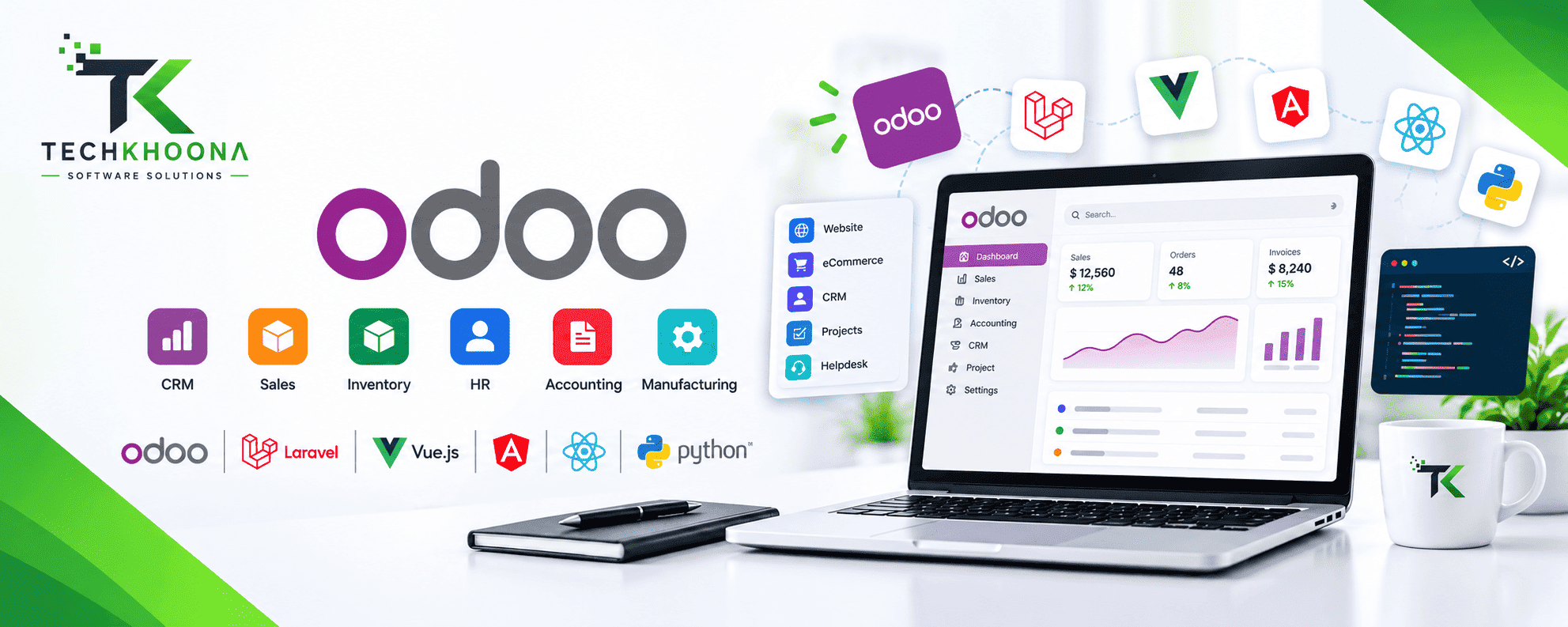
Powered by Odoo
The world's most installed open-source ERP
How We Work
A practical approach from requirements to long-term support.
Understand
We learn about your processes, users, and software requirements.
Design
We map the solution to your workflows and define the implementation approach.
Implement
We configure, customize, integrate, and prepare the system for use.
Train
We train users and provide the knowledge needed for day-to-day operation.
Support
We provide ongoing maintenance, troubleshooting, updates, and support.
What Exactly Is Odoo?
One open-source suite, one database, one login — and only the modules you actually need.
Not just an ERP — an integrated suite.
Odoo is an open-source suite of integrated business applications. Instead of buying a separate CRM, accounting package, inventory system, and website builder, you install Odoo once and enable only the modules you need. They share one database, one login, and one interface — so a sales order automatically creates an invoice, updates inventory, and triggers a delivery, with no manual re-entry and no integration middleware to maintain.
Read Our Odoo Blog
Why Odoo for Your Business?
All our solutions are built on Odoo – the world's most installed open-source ERP. This means you get enterprise-grade features with the flexibility of open source.
Seamless Integration
Secure & Reliable
Modular & Scalable
Pashto / Dari / English
Custom Software Development
Beyond ERP: we build, integrate, and modernize the software your operations actually need — on Odoo or standalone.
Custom Odoo Modules
Need a workflow Odoo doesn't ship with? We design and build custom modules — from field-service dispatch to donor management — and keep them upgrade-safe across Odoo versions.
Third-Party Integrations
Connect Odoo to payment gateways, SMS providers, local tax authority APIs, e-commerce platforms, and legacy databases — with retry logic and error monitoring built in.
Data Migration
Moving from spreadsheets, QuickBooks, or an older ERP? We extract, clean, validate, and import historical data with full reconciliation reports before go-live.
Ongoing Support & Upgrades
Version upgrades, security patches, performance tuning, and bug fixes — with a named support contact and documented SLAs, not a ticket queue.
Our Software Solutions
Odoo-powered ERP systems tailored for businesses and organizations
Hospital Management
Manage patients, appointments, pharmacy, laboratory, billing, and medical records.
Learn More
Educational Institute
Student admissions, attendance, examinations, fees, and academic management.
Learn More
HR Management
Manage employees, attendance, payroll, recruitment, appraisals, and complete workforce lifecycle.
Learn More
Timesheets Management
Track employee hours against projects and tasks, organize daily and weekly time entries, and analyze logged work time.
Learn More
Inventory Management
Multi-warehouse management, stock tracking, receiving, shipping, and inventory valuation.
Learn More
CRM Management
Manage leads, opportunities, customers, sales activities, follow-ups, and your complete sales pipeline.
Learn More
Invoicing
Create, send, and manage customer invoices and vendor bills. Track payments, credit notes, and outstanding balances.
Learn More
Odoo Discuss
Real-time team communication, chat, video calls, file sharing, and collaboration fully integrated with Odoo.
Learn More

Restaurant Management
Manage tables, orders, POS, kitchen operations, inventory, and customer billing.
Learn More
Shop Management
POS, inventory, purchasing, accounting, customers, suppliers, and retail operations.
Learn More

Pharmacy Management
Medicine inventory, prescriptions, expiry tracking, suppliers, and billing.
Learn More

Clothing Store
Manage clothing inventory, POS, customers, suppliers, and real-time sales analytics.
Learn More
Manufacturing Management
Manage Bills of Materials, Manufacturing Orders, Work Centers, production planning, and traceability.
Learn MoreReady to Transform Your Business?
Contact us today and get a demo tailored to your organization.
Contact Us NowWe provide full Odoo implementation, training, and support.
Frequently Asked Questions About Odoo
Is Odoo an ERP system?
Yes. Odoo is widely used as an ERP platform, but it is broader than a traditional ERP because it also includes applications for CRM, websites, eCommerce, marketing, project management, helpdesk, point of sale, and other business functions.
Can Odoo be customized?
Yes. Odoo is designed to be extended through modules and its development framework. Developers can create new applications, extend existing applications, add workflows, create reports, customize interfaces, and integrate Odoo with external systems.
Can Odoo be used for industry-specific software?
Yes. Odoo can be extended to support industry-specific workflows and specialized business requirements. The appropriate approach depends on whether the requirement can be handled through configuration, an existing module, or custom development.
How long does an Odoo implementation take?
Implementation time depends on the scope of the project. A focused deployment with a few standard applications can be completed in a few weeks, while larger implementations with custom modules, integrations, and data migration typically take several months. A proper requirements analysis is the first step in estimating a realistic timeline.
Can Odoo be integrated with existing systems?
Yes. Odoo can exchange data with external systems through APIs, web services, controllers, and scheduled jobs. Common integration targets include websites, eCommerce platforms, payment gateways, SMS and email services, accounting systems, warehouse and barcode hardware, and third-party business applications.
What is the difference between Odoo Community and Odoo Enterprise?
Odoo Community is the free, open-source edition that provides the core platform and a broad range of business functionality. Odoo Enterprise is the paid, subscription-based edition that builds on Community and adds additional applications, professional support, upgrades, and hosting-related services. The right choice depends on business requirements, support expectations, and budget.
Can I migrate data from my existing system to Odoo?
Yes. Data migration is a standard part of most Odoo implementations. Customer records, products, suppliers, opening balances, and historical transactions can be imported into Odoo after the data has been cleaned and mapped to the appropriate Odoo models. A well-planned migration includes validation and testing before go-live.
How is Odoo deployed?
Odoo can be deployed in several ways: Odoo Online (fully hosted), Odoo.sh (cloud development and hosting), on-premise on your own infrastructure, or using container-based infrastructure such as Docker. The appropriate model depends on security policies, data residency requirements, integration needs, and available technical resources.
Does Odoo support multiple languages and currencies?
Yes. Odoo supports many languages and multiple currencies. Interfaces, documents, and reports can be localized, and Odoo includes support for right-to-left languages such as Pashto, Dari, and Arabic. Multi-currency operations are supported in sales, purchasing, invoicing, and accounting.
Is Odoo suitable for small businesses?
Yes. Odoo is used by organizations of all sizes, from small businesses to large enterprises. Small organizations often begin with a focused set of applications — such as CRM, Sales, Invoicing, and Inventory — and expand the platform as their requirements grow.
How much does Odoo cost?
Odoo Community is free to use. Odoo Enterprise is subscription-based, and the cost depends on the number of users, selected applications, and hosting arrangement. Beyond licensing, organizations should also consider implementation, customization, training, hosting, and ongoing maintenance costs when planning a budget.
Can Odoo be customized without modifying the core?
Yes. Best practice is to extend Odoo through custom modules rather than modifying the core source code. This keeps future upgrades, testing, and maintenance manageable because custom functionality remains separate from the standard framework.
What kind of support is available for Odoo?
Support options vary by edition and provider. Odoo Enterprise subscriptions include access to Odoo's support services. Organizations using Odoo Community typically rely on internal teams, community resources, or a partner for implementation, customization, and technical support.